Dr. Teo with pangolin
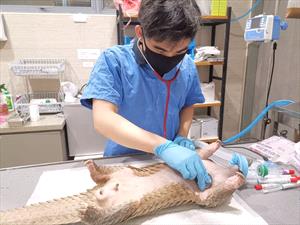
Photo courtesy of Dr. Teo Boon Han
Dr. Teo Boon Han checks over a wild pangolin after a near accident on the road. Teo is president of the Singapore Veterinary Association.
Two decades ago, Singapore had around 100 veterinarians. Today, more than 650 are licensed to practice in the Southeast Asian city-state.
The remarkable growth, driven in large part by a rise in pet ownership, has propelled lawmakers to rectify what many see as a glaring shortcoming: the lack of a dedicated veterinary regulator.
The proposed Singapore Veterinary Council, expected to go live next year, would issue licenses to veterinarians, handle disciplinary matters, set continuing education requirements and uphold standards of conduct and ethics. The council is being modeled on professional regulators in other countries such as the Royal College of Veterinary Surgeons in the United Kingdom and state-based veterinary boards in the United States.
While many countries with emerging economies don't have a dedicated veterinary regulator — Cambodia, Laos and Vietnam being cases in point in Southeast Asia — it's unusual for a wealthy country like Singapore to lack one. The planned establishment of a veterinary council is evidence that countries throughout Asia are starting to embrace pet ownership like their Western counterparts.
"For many years, our cultural attitude to pets was different," said Dr. Teo Boon Han, president of the Singapore Veterinary Association, the country's main advocacy group for the profession. "People just saw it as playing with puppies and kittens. But that's changed as the human-animal bond has strengthened in Singapore."
Even with the establishment of a veterinary council, development of the profession in Singapore will have some way to go, according to veterinarians who work there. For one, Singapore doesn't have a veterinary school, meaning aspiring practitioners must study abroad — predominantly in Australia, the U.K. and, to a lesser extent, the U.S. Efforts to convince the government to help establish a domestic veterinary school haven't gotten far to date.
Moreover, the level of pet ownership in Singapore, even having risen in recent years, remains low compared with that of many other wealthy countries.
"There's still huge potential for growth," Teo, a graduate of Britain's Royal Veterinary College, said, adding that more veterinarians are needed to meet rising demand. "People don't feel like the labor market's too saturated," he said. "In fact, there's still a shortage of vets and vet clinics here."
Dr. Rina Maguire hopes more specialists will be attracted to work in Singapore.
Having studied at the University of Sydney, she then spent eight years practicing in Manhattan and Long Island in New York, alongside her practitioner husband, Dr. Patrick Maguire, a veterinary surgeon, before returning to Singapore. In 2019, the couple founded what is now a 20-doctor specialty and emergency hospital that includes the country's first dedicated avian and exotics clinic. (Rina Maguire, a U.S. board-certified specialist in exotic companion mammal medicine, also served as resident veterinarian at the Singapore Zoo and Jurong Bird Park for two years.)
"We really liked the way practices were run in the States and we want to bring that way of practicing into this country — that referral-based specialty medicine," she said.
Maguire noticed Singapore's veterinary community beginning to flourish on her return home. The veterinary council, she suspects, could accelerate its evolution by raising public awareness of specialists' capabilities.
"Before we moved back, there were only a small number of [general medicine] practices that were trying to offer more advanced-level medicine, and the profession here was still developing in terms of specialist training and support," she said. "Everyone was a lot more isolated — they'd come back home and they'd set up their own little practice. Now, we have specialist referral hospitals, we have 24-hour care. There's definitely a boom."
Leaning toward 'small, white fluffies'
Around 36% of households in Singapore owned a pet in 2021, according to a survey of 97,000 people across Asia conducted that year by Rakuten Insight, a Tokyo-based market research company. That compares with levels well north of 60% in places such as the U.S., the U.K. and Australia. Another difference is that a relatively large proportion of Singapore pets are little animals like fish and hamsters. Only 17% of of the survey respondents had a dog, and 10% a cat.
As for practitioners, more than 90% treat companion animals; most of the rest work in government research or at the Singapore Zoo. The island country has few large animal practitioners, owing to a modest-sized agriculture industry.
That partly explains why the government had been reluctant to allocate resources to beefing up regulation in the veterinary sector, according to Dr. Haoting Chow, a companion animal practitioner and past president of the Singapore Veterinary Association.
"In many other countries, agriculture contributes more extensively to their GDP," he said, referring to gross domestic product, "so there is an economic incentive to have a more robust veterinary infrastructure."
He continued, "I don't think the decision now to form the vet council in Singapore is so much an economic one but more a response to a public push, because there's an increased awareness of the concept of animal welfare.
Haoting said companion animal medicine conceivably could become a larger contributor to Singapore's economy if the pet culture continues to grow.
Dr. Rina Maquire
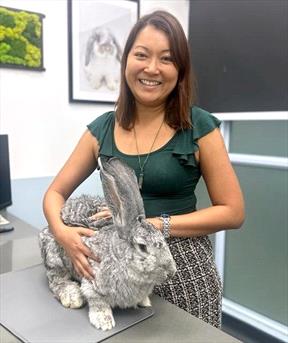
Photo courtesy of Beecroft Animal Specialist & Emergency Hospital
Exotics specialist Dr. Rina Maguire, shown with a rabbit patient, spent eight years practicing in Manhattan and Long Island before returning home to Singapore, where she cofounded a speciality and referral hospital with her husband, Dr. Patrick Maguire.
Singapore isn't the only developed Asian country with a relatively low — if growing — level of pet ownership. Only 28% of people in Japan and 34% of people in South Korea own pets, according to the Rakuten Insight survey.
Rising pet ownership in Japan, Singapore and South Korea has been accompanied by falling human birth rates, pinned on factors like higher living costs and shifting cultural attitudes. South Korea, for instance, has the lowest birth rate in the world, at 4.76 babies born per 1,000 people in 2025, according to World Population Review.
"People — and this is happening globally — aren't having kids. They're having fur kids instead," Teo said. "And people here are spending more on each pet, not just on medical care but on things like fresh pet food, boarding facilities and grooming services."
There was far less enthusiasm for keeping pets in many parts of Asia 50 or 60 years ago, according to Haoting.
"For my parents' generation, pet ownership is a bizarre concept," he said. "I think their priority was nurturing the human family and putting food on the table. My mum would say, 'What's the point? It's just an animal. And why would you bring it inside the house when it carries bacteria and stuff?' So I think there's some cultural changes from generation to generation."
Cultural differences were apparent to Haoting when he studied veterinary medicine at the University of Melbourne. "A lot of my Australian classmates, they grew up with pets," he said. "Their parents had pets, their grandparents had pets, so it's natural for them. For us, it is a brand new concept."
Space, or more precisely, a lack thereof, also affects ownership in tightly packed places like Japan and Singapore. For instance, in Singapore, population 6.1 million, an average of 8,300 people occupy each square kilometer (0.386 square miles) of land, according to government figures, making it one of the most densely populated countries on Earth. The Singaporean government limits the total number of cats and dogs to three in any single private premise.
One workaround for coping with space constraints is keeping smaller pets.
"We have cats, we have rabbits, we have guinea pigs and hamsters," Haoting said. "We have dogs, as well, but tend to have smaller dogs. The small, white fluffies."
Maguire, for her part, attributes ultra-rapid growth in the profession to a sudden recognition by Singaporeans of what veterinarians can do, coupled with the emergence of increasingly sophisticated technology like enhanced diagnostics.
"Before, there weren't many options, so people thought that was it. That was the amount of care they had," she said. "I think when people were exposed to something better then they realized, 'Ok, maybe I can do more. Maybe I won't just stop at giving pain relief.' "
Improving the existing framework
Veterinarians in Singapore currently are regulated by the Animal and Veterinary Service (AVS), an arm of the government's National Parks Board. Similar to the Department for Environment, Food and Rural Affairs in the U.K., the Singapore parks board has many functions, serving as the "lead agency for greenery, biodiversity conservation, and wildlife and animal health, welfare and management."
Dr. Haoting Chow
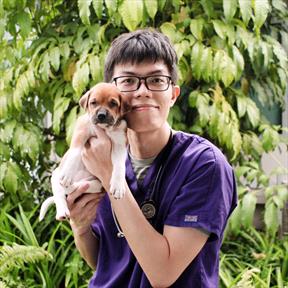
Photo courtesy of Dr. Haoting Chow
Dr. Haoting Chow, shown with a rescue puppy, says pet ownership was a bizarre concept to his parents and grandparents.
The Singaporean government announced on Oct. 24 that it would launch a one-month public consultation on the proposed veterinary council by the end of this year. The new regulator, it said, "will provide pet owners with greater assurance that their veterinarians meet established professional standards and are held accountable for their practice."
Parliament is expected to approve the new regulator unopposed. (Singapore is broadly considered to be a quasi-democracy — the ruling People's Action Party has been in power for 66 years.)
Teo doesn't see veterinarians noticing much of a change to their day-to-day lives immediately after the new regulatory agency is formed, since many functions, such as issuing licenses, will simply transfer from the AVS to the veterinary council.
Rather, the regulator's significance will become more apparent over the medium and long term, he believes.
"It won't just be a top-down thing anymore — the government giving us direction. It'll be the vet profession having a larger voice in leading itself in terms of governance and innovation," he said. "It will allow the vet council, when it's considering the needs of the animal and veteirnary industries, to be more nimble."
Offering veterinarians more sway, he added, will help the profession navigate technological disruption. "Globally, there are so many changes occurring in technology, like AI, for example. There are novel therapies emerging that are at the frontier of veterinary medicine."
Ultimately, the council, Teo said, would provide a credibility boost. "It recognizes that veterinary medicine is a proper, fully-fledged profession. All the other big professions in Singapore have their own governing body, whether it's the law society, medical council for human doctors, dental council or engineers board."
Haoting envisions the council lifting the overall performance of the profession. "In any industry, you're going to have some black sheep, and a robust veterinary council will really help to improve overall standards," he said.
Maguire hopes it will enable veterinarians to communicate as a profession more effectively with the public, including on animal welfare issues such as discouraging the confinement of songbirds to small cages as ornaments, a practice still common throughout Asia.
"There's not a professor who’s heading the university in Singapore who’s a spokesperson for vets or anything like that," she said. "That's what’s lacking, I think, that kind of interface. Maybe the vet council will be a place where we can get a voice in."